If your website ranks for a handful of keywords but your phone still isn’t ringing, the problem usually isn’t your rankings — it’s your SERP visibility. Many business owners check one or two keyword positions, see a “good” number, and assume their SEO is working. Meanwhile, competitors are quietly showing up across dozens of related searches, local packs, and featured snippets, capturing the traffic that never reaches your site at all.
At Trometech, we work with Denver and Aurora businesses every day who are ranking somewhere, just not everywhere it counts. This guide breaks down what SERP visibility actually means, how it’s different from a simple ranking check, and what you can do to grow it.
What Does SERP Visibility Mean?
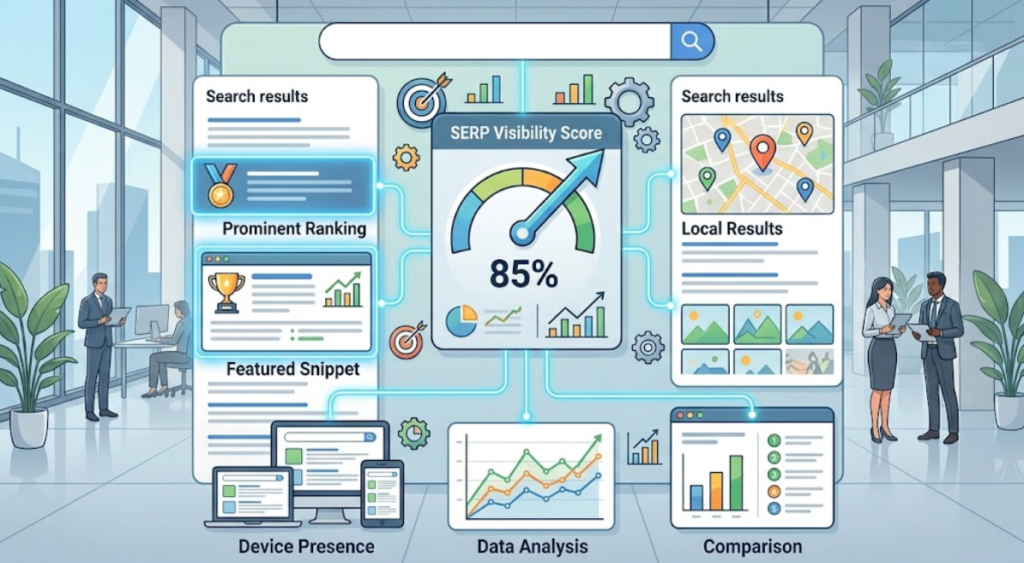
SERP visibility is a measure of how often and how prominently your website shows up across the full range of search engine results pages (SERPs) relevant to your business — not just for one target keyword, but across your entire topic and keyword footprint.
A single ranking answers one narrow question: “Where do I sit for this exact phrase today?” SERP visibility answers a much bigger one: “How much of the search landscape around my business do I actually own?”
That landscape now includes more than the traditional ten blue links. It can include:
- Standard organic results
- Featured snippets and “People Also Ask” boxes
- Local map pack listings
- Image and video results
- Shopping listings
- AI-generated search summaries
- Branded searches for your company name
A business that shows up consistently across several of these formats, for dozens or hundreds of relevant queries, has strong SERP visibility — even if it never holds the number-one spot for its biggest keyword.
SERP Visibility vs. Keyword Rankings: Why the Distinction Matters
Think of an individual keyword ranking as a single data point and SERP visibility as the whole map.
Imagine a Denver plumbing company ranks #3 for “plumber Denver” but shows up nowhere for “emergency water heater repair Denver,” “how to fix a leaking pipe,” or “licensed plumber Aurora CO.” That single strong ranking looks impressive on a report, but the company is invisible for dozens of searches its actual customers are typing every week.
Now imagine a competitor ranks #6 through #9 for that same core term, but also appears for 150 related local and informational searches, shows up in the map pack, and earns a featured snippet on a common question. That business is capturing far more total demand, even without the flashy #1 position.
This is exactly why we encourage clients to think in terms of visibility rather than chasing a single rank. It’s a theme we’ve explored before in our piece on why content marketing is the core of every SEO strategy — breadth of relevant, useful content is what expands your footprint across the SERP in the first place.
How Search Engines Decide What Gets Shown
Google isn’t matching keywords like a simple find-and-replace tool. Its systems evaluate relevance, content quality, site trustworthiness, technical accessibility, and user experience together to decide which pages deserve visibility for a given search.
That means improving SERP visibility isn’t about repeating a keyword more often. It’s about proving, through the structure and substance of your website, that you’re the most useful answer to a real question. Google’s own guidance consistently points toward helpful, people-first content and away from pages built primarily to game the algorithm.
For a local business, this has a practical implication: visibility is earned through a combination of factors working together, not a single trick.
The Core Factors That Drive SERP Visibility
Search Intent
Before optimizing any page, ask what the person searching actually wants. Someone typing “what is SERP visibility” wants an explanation. Someone typing “SEO company near me” wants a business they can hire today. Someone typing “SEO pricing Denver” is comparing options. Matching your page format and content to that intent is one of the fastest ways to earn a spot in relevant results.
Topical Depth
A single page rarely earns broad visibility on its own. Search engines reward websites that cover a topic thoroughly, with supporting content that naturally references related concepts — organic traffic, keyword research, technical SEO, local search, and so on — rather than one isolated article stuffed with a single phrase.
Technical Health
Even excellent content can stay invisible if search engines can’t crawl, render, or index it properly. Broken internal links, missing sitemaps, duplicate URLs, slow load times, and poor mobile usability all quietly cap how much visibility a site can earn, no matter how good the writing is. This is one of the most common issues we uncover during a Denver SEO audit — sites with strong content that search engines simply can’t fully access.
Internal Linking
Linking your related pages together — for example, connecting a guide like this one to your core service pages — helps both users and search engines understand how your content fits into a larger topic, which supports visibility across more of that topic’s related searches.
Backlinks and Authority
A handful of relevant links from credible, related sources tends to do more for visibility than a large pile of unrelated ones. Authority builds slowly, through genuinely useful content, real partnerships, and expertise that other sites want to reference.
User Experience
A page that ranks but frustrates visitors — slow to load, cluttered, hard to read on mobile — undermines the very visibility it earned. Clean design and clear navigation, the kind we build into every website development project, keep visitors engaged long enough for that visibility to actually convert.
How to Measure Your SERP Visibility
Google Search Console remains the most reliable free tool for this. A few metrics matter most:
Impressions show how often your pages appeared in search results at all. Rising impressions mean you’re showing up for more searches or appearing more often for existing ones.
Average position gives a broad sense of where your pages tend to land, though it varies by query, device, and location, so treat it as a trend indicator rather than a fixed score.
Click-through rate (CTR) shows what percentage of those impressions actually turned into a visit. High impressions paired with a low CTR often point to a weak title tag or a mismatch between your page and what searchers expected.
Keyword coverage tracks how many relevant queries you appear for in total — not just your five target terms, but the long tail of related searches around your business.
Watching all four together, rather than fixating on one, gives a far more accurate read on whether your visibility is actually growing.
A Simple Example
Picture a Denver-based HVAC company that historically tracked one keyword: “HVAC repair Denver.” Rankings hovered around position 7, and traffic was flat for months.
After a broader review, the company found dozens of related searches it never appeared for at all — “furnace making noise,” “AC not cooling Denver,” “how often to replace HVAC filter,” “emergency heating repair Aurora.” By publishing genuinely useful content around these questions, cleaning up technical issues limiting indexing, and linking new pages back to its core service pages, the company began appearing for hundreds of relevant queries within a few months.
Its flagship keyword didn’t necessarily jump to #1. But its overall SERP visibility, and the qualified traffic that came with it, grew substantially — because visibility, not one ranking, was the real goal.
Steps to Improve SERP Visibility
- Audit your current visibility. Use Search Console to see which queries you already show up for, and where impressions exist without matching clicks.
- Map out topic clusters. Build a core page supported by related articles that address the full range of questions your customers actually ask.
- Fix technical gaps first. Indexing problems, broken links, and slow pages cap visibility no matter how good the content is.
- Strengthen titles and snippets. A clear, specific title earns clicks even from a mid-tier position.
- Link your content together. Connect new articles to your core service pages so both users and search engines understand how everything relates.
- Track outcomes, not vanity numbers. A growing keyword count matters far less than whether that visibility produces real leads and customers.
Common Mistakes That Limit Visibility
The most frequent mistake is measuring SEO success by a single keyword instead of the full picture. Close behind is publishing content without understanding search intent, or leaving technical indexing issues unresolved for months at a time. Businesses also sometimes give up on pages sitting at position 12–20 that, with a few targeted improvements, could move into much stronger territory.
Frequently Asked Questions
What is SERP visibility in simple terms?
It’s a measure of how often and how prominently your website appears across all the searches relevant to your business, not just one target keyword.
Is SERP visibility the same as ranking?
No. A ranking is your position for one specific query. Visibility describes your presence across many related queries and search features combined.
How can I check my SERP visibility?
Google Search Console is the best starting point, using impressions, average position, CTR, and total keyword coverage together.
Why does my site get impressions but very few clicks?
This usually points to weak title tags, low average positions, or a mismatch between your page and what the searcher expected to find.
How long does it take to improve SERP visibility?
It depends on your industry, competition, and current site health, but most businesses see measurable movement within a few months of consistent, intent-focused work.
Building Visibility That Actually Converts
Strong SERP visibility isn’t the result of one clever trick — it comes from search intent, technical health, useful content, and internal structure all working together over time. The goal isn’t to win the top spot for one phrase; it’s to become the consistent, trustworthy answer across everything your customers are actually searching for.
If your Denver or Aurora business is getting some visibility but not enough qualified traffic, talk to our team about a focused SEO audit. We’ll show you exactly where your biggest visibility gaps are and which fixes will move the needle first.